
Luscid | 18 August, 2026
The Sponsorship Brief Is Changing: What Brands Are Asking From Partnerships in 2026
Sponsorship has become capable of doing far more for a brand.
A single partnership can now be expected to reach a priority audience, strengthen specific brand associations, generate content, improve an experience, demonstrate a product, reward customers and contribute to measurable commercial outcomes.
That changes the brief.
Stats Perform’s 2026 research, based on responses from 675 sports-media executives globally, gives one indication of how expectations are shifting. 70% say sponsors are demanding more digital content, while more than one-third still struggle to find authentic ways to integrate sponsors into the property. Nearly half expect to expand their international sponsorship portfolios, and more than half are increasing investment in women’s sport (Stats Perform). Indeed, across the last 12 months in the Luscid platform, 3 of the top 10 requested brand values are related to inclusivity and diversity.
The opportunity set is growing at the same time as the number of outcomes brands expect from it.
For marketers, that makes the quality of the sponsorship brief increasingly important.
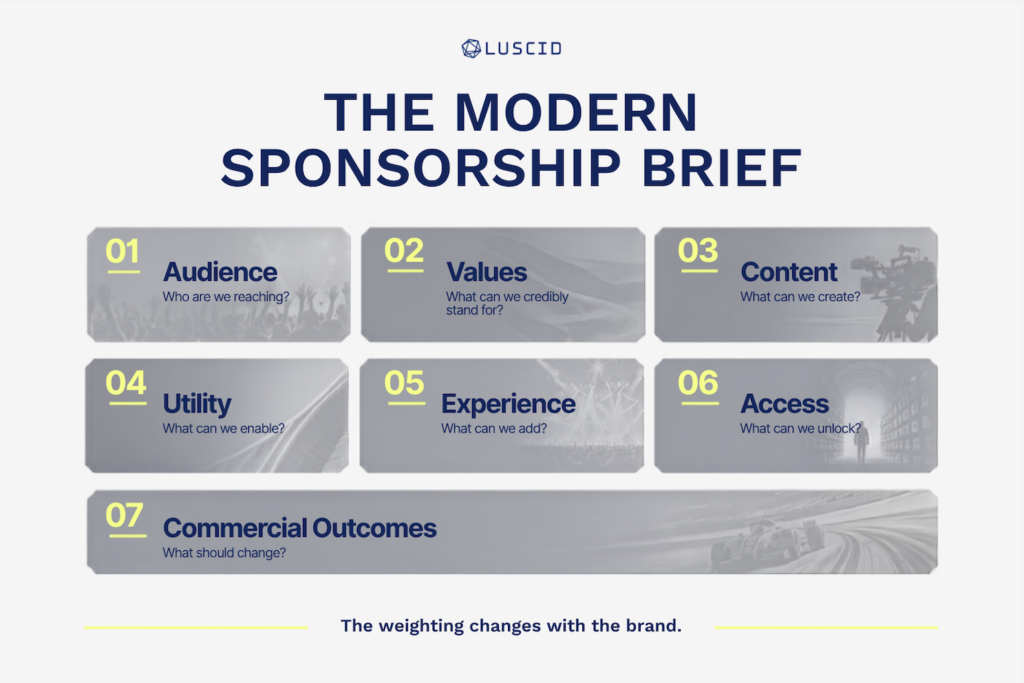
Seven questions are becoming central to that brief.
1. Audience: who are we actually trying to reach?
Audience remains the starting point.
What has changed is the amount of context now available around it.
A headline reach figure can tell a brand how many people might see a partnership. It says considerably less about how those people behave, what they buy, where else they spend their time or how deeply they engage with the property.
This becomes even more important as fandom moves across multiple environments.
PwC describes modern sports fandom as an increasingly connected ecosystem spanning tickets, streaming, social content, commerce and membership. A few hours around a live event can now develop into a year-round relationship, while owned digital platforms give properties more information about fan preferences, interactions and purchasing behaviour (PwC).
The same behaviour exists across music, entertainment and culture. People discover an event online, buy tickets, travel to it, create content around it, purchase merchandise and continue following the people or institutions involved afterwards.
So the audience question is becoming more precise:
Are enough people there — and are they the people whose behaviour matters to the business?
That is a much more useful starting point than scale alone.
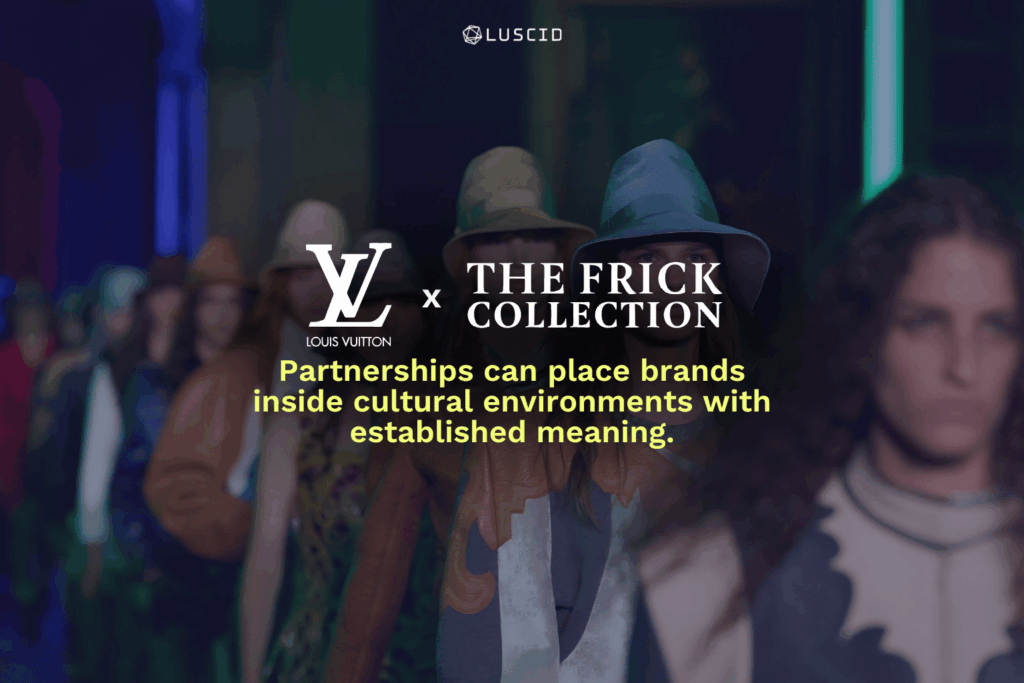
Photo credits: Mojeh
2. Values: what does this environment help the brand stand for?
The second part of the brief is about meaning.
People encounter brands inside environments that already carry cultural associations. Music, art, football, fashion, tennis and gaming each provide very different contexts for the same brand.
Those associations matter commercially.
The 2026 Edelman Trust Barometer Special Report, based on 17,688 respondents across 15 countries, found that 88% consider trust in a brand an important or critical purchase criteria. That puts trust almost level with quality at 89% and value at 88%. Edelman also identifies utility, identity, community, emotion and cultural fluency as different ways brands can create relevance (Edelman). From a Luscid perspective, the values of Trust and Integrity are common selections when brands are selecting the values that are most important synergise with in a partnership.
Live music demonstrates the identity component particularly well.
Live Nation’s global fan research finds that 78% of fans consider music a core part of their identity, while 67% describe a live music event as one of the most memorable moments of their lives. Among Gen Z, 83% say they are interested in the brands sponsoring live music events (Live Nation). This supports the results of a recent Luscid report for a 16-24 year old European audience – where Live Events and Music were both in the top 3 passions for an awareness focussed partnership solution.
Art offers a different kind of association.
In May 2026, Louis Vuitton began a three-year cultural sponsorship of The Frick Collection in New York. The partnership supports three major exhibitions, curatorial research and public programming. It also funds the First Fridays, providing free after-hours access to the museum from June 2026 through May 2027 (The Frick Collection)
For Louis Vuitton, the cultural environment provides credible territory around craftsmanship, heritage, artistic research and creative expression. In a recent Luscid report for a luxury fashion brand – Art was well represented in the top 10 passion points, with the likes of Fine Art and Classical / Opera performing strongly.
The strategic question is therefore deeper than whether the audience likes the brand.
Which associations already exist within this environment, and which of them are valuable to the brand we are trying to build?
3. Content: what does the partnership give us permission to create?
Content is becoming part of the value of the rights themselves.
The fact that 70% of respondents in Stats Perform’s survey report growing sponsor demand for digital content is significant. Luscid data reveals that across sporting genres, 70% of individuals claiming interest in a sport follow their passion across social media channels more than anywhere else.
However, research also identifies an authenticity gap: more than one-third still struggle to integrate sponsors organically (Stats Perform).
More content therefore does not automatically create more value.
The property needs to give the brand a credible reason to participate in the conversation.
Spotify’s involvement in the 2026 Los Angeles Times Festival of Books is a good example. Spotify served as presenting sponsor of the Audiobook and Podcast Stage, building programming around authors, audiobooks, podcasts and storytelling across formats (Spotify).
The environment connected directly with an area of Spotify’s product offering. That gave the brand legitimate subject matter to explore.
This changes the content question inside the brief.
It becomes:
What stories will this partnership allow the brand to tell credibly for the next twelve months?
The answer has implications for social, PR, creators, owned channels, customer communications and potentially the wider media plan.
4. Utility: what can the partner actually enable?
One of the more significant developments in sponsorship is the growing functional role of partners.
Technology provides some of the clearest examples.
Microsoft’s five-year Premier League partnership goes deep into the league’s digital ecosystem. The Premier League Companion, powered by Microsoft Copilot, draws on 30 seasons of statistics, 300,000 articles and 9,000 videos. Microsoft technology also supports the league’s cloud infrastructure, internal operations and development of new fan experiences (Microsoft).
The NBA and AWS partnership follows a similar principle. NBA Inside the Game powered by AWS is designed to transform billions of data points into new statistics and interactive experiences. Its tracking system analyses 29 data points per player, using AI and machine learning to create new ways for fans and broadcasters to understand what is happening on court (NBA).
The partner contributes to the property’s capability.
That creates a powerful proposition for brands whose products can genuinely improve performance, operations, transactions, content or fan experience.
It also changes the sponsorship question.
What can our business make possible here?
For some categories, demonstrating the answer in a live environment may be one of the strongest pieces of marketing the partnership can produce.
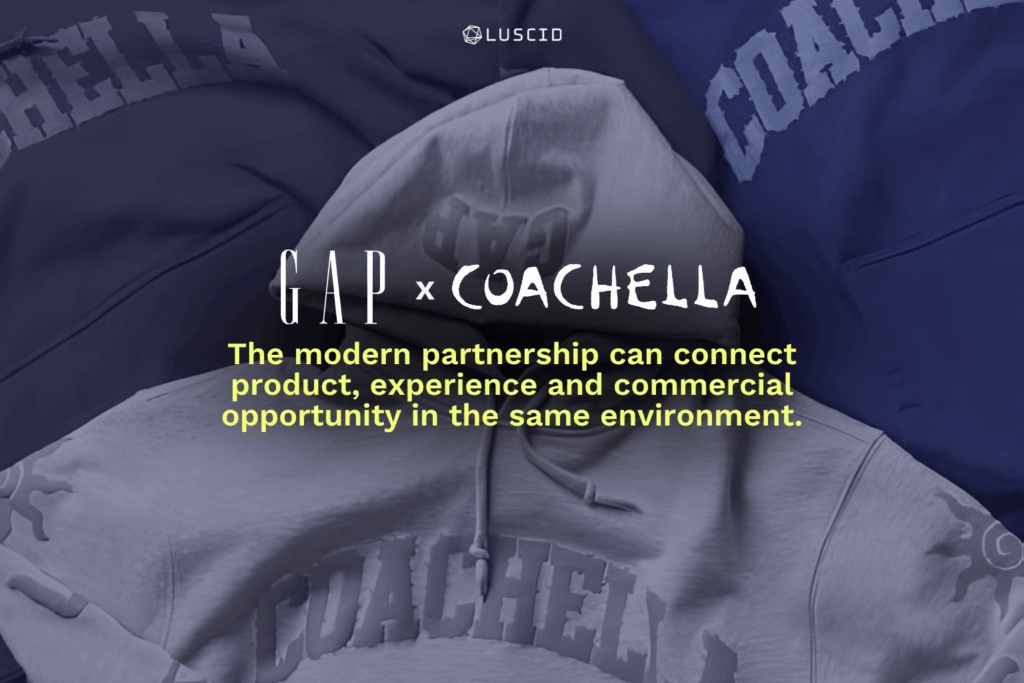
Photo credits: GAP
5. Experience: what will people actually remember?
The physical experience around events is also expanding.
Live music provides a useful illustration because the event itself increasingly influences travel, hospitality, fashion, food and wider consumer spending.
Live Nation reports that in 2025, 40% of live music attendees travelled at least 500 miles for a music event, two-thirds of festival attendees came from outside the local area, and six in ten fans travel for shows during the year (Live Nation).
A recent Luscid report created in our brand new Rights-Holder Sector Evaluation tool evaluated 250 consumer and B2B sectors against a European Live Music Festival, and 5 of the top 10 consumer sectors were travel related.
A festival sponsorship therefore sits inside a much larger customer journey than the time spent watching a performance.
Gap’s 2026 partnership with Coachella shows how a brand can respond to that environment.
As the festival’s exclusive clothing apparel sponsor and official merchandise partner, Gap created Hoodie House, combining a limited-edition product with personalisation, collectible patches and charms, lounge space and membership benefits. The exclusive Gap × Coachella hoodie retailed at $100, with onsite customisation available for an additional $10 (Variety).
The activation connected brand experience directly with the product itself.
It also addressed a real aspect of the festival experience: clothing, personal style, changing temperatures, downtime and self-expression.
That provides another useful question for the brief:
What can the brand add to the experience that people will actually use, participate in or remember?
6. Access: what becomes available because the partnership exists?
For some categories, access can become the customer benefit itself.
American Express is a particularly clear example.
At American Express presents BST Hyde Park in 2026, eligible Cardmembers could receive 5% back on qualifying onsite purchases, use dedicated merchandise lanes, access Cardmember areas and receive additional festival benefits (American Express).
The sponsorship therefore has a direct relationship with product usage and membership value.
Culture provides another version of the model.
Bank of America’s Museums on Us gives eligible cardholders free general admission to participating cultural institutions across the US during the first full weekend of every month. During the July 4 weekend in 2026, the programme expanded access to 250 cultural and civic institutions nationwide as part of the bank’s America 250 programme (Bank of America).
Here, cultural partnership becomes part of the customer proposition.
That creates a straightforward question:
What can we give our customers through this partnership that they would value outside our core product?
For membership, financial services, travel and hospitality brands in particular, the answer can become a significant part of the commercial rationale.
7. Commercial outcomes: what should actually change?
Eventually, every sponsorship brief reaches the business question.
What is the investment expected to change?
Awareness may be one outcome.
Others could include consideration, product trial, transaction volume, customer acquisition, retention, membership usage, enterprise leads, hospitality, market entry or direct sales.
Marketers increasingly say they want that connection to business outcomes.
Nielsen’s Marketing ROI Blueprint found that 38% of marketers now identify sales or ROI as their leading success metric. Yet the same research reveals a measurement gap: 85% say they are confident in their ability to measure ROI, while only 32% actually measure it holistically across traditional and digital media. And 27% still measure sponsorship separately from the wider media ecosystem (Nielsen).
That tension matters.
The sponsorship brief is becoming broader while measurement remains fragmented.
If a partnership has been designed to influence audience perception, content performance, customer experience and sales simultaneously, measuring only media exposure will inevitably capture an incomplete picture.
Commercial outcomes therefore need to enter the brief at the beginning.
They help determine which of the other six dimensions deserve the greatest attention.
The same property can have very different value depending on who is asking
This is perhaps the most important implication of the changing brief.
Consider a large music festival.
A soft-drinks brand might see audience, product trial and experience.
A fashion brand might prioritise cultural associations, content and commerce.
A payment company might focus on transactions, access and customer rewards.
A technology business could identify opportunities around infrastructure, connectivity or digital experience.
The property has not changed.
The brief has.
This is also where contextual data becomes useful.
In one Luscid analysis built specifically around AI brands, Formula E indexed at 4.2x stronger than average in terms of positive sentiment association with Technology and 4.6x for Innovation, while Wimbledon indexed at 1.9x and 2.1x respectively.
Those numbers are useful because they answer a defined question for a defined category.
Run the same properties against a luxury brand, a payment company or an FMCG brief and the relevant audience, values and objectives change. The evaluation should change with them.
This is why the search for a universally “best” sponsorship property is increasingly unhelpful.
The useful question is:
Which opportunity is strongest against the job this particular brand needs sponsorship to do?
A broader brief requires clearer priorities
Audience. Values. Content. Utility. Experience. Access. Commercial outcomes.
The modern sponsorship brief can contain all seven.
It rarely makes sense for all seven to carry equal importance.
A technology company trying to prove capability may place significant weight on utility.
A luxury brand entering a new cultural territory may care more about values, audience and access.
An FMCG business launching a product may prioritise audience, experience, trial and commercial conversion.
A financial-services company building loyalty might place access and customer benefits much higher.
That weighting should happen before the shortlist is selected.
Because the growing sophistication of sponsorship is creating more ways for a partnership to generate value. It is also creating more ways to choose the wrong opportunity for the right reasons.
The quality of the brief is therefore becoming one of the most important parts of the decision.
Define what the partnership is expected to achieve. Understand which dimensions matter most. Then evaluate opportunities against that same logic.
Sponsorship works better with clarity.




Stay Updated with Luscid
Be the first to receive exclusive sponsorship insights, industry trends, and platform updates.